Key Issues
At the Minnesota Chamber of Commerce, our policy agenda comes directly from our members, the businesses who drive the state’s economy.
Through policy committees, surveys, and our Statewide Policy Tour, members raise the challenges they face every day including taxes, workforce, mandates, health care, transportation, energy and more. Our policy committees draft recommendations, our Board of Directors approves them and our advocacy team works at the Capitol to advance them every day in and out of the legislative session.
Explore key issue areas







2026 session priorities
Minnesota enjoys great strengths as state: a highly developed, innovative and diverse economy, a skilled and reliable workforce along with best-in-class class health care, quality infrastructure and enviable natural resources that all contribute to and enhance our quality of life. A growing, successful private sector economy funds and supports this high quality of life and the programs and services many Minnesotans rely on.
The state’s economy is capable of strong and sustained growth. But costs are too high, demographics are working against us, and a sense of urgency and vision for the state’s economic future need to be articulated and agreed upon.
TAXES – Improve competitiveness
Conforming to pro-growth tax policies contained within the 2025 federal tax bill, particularly bonus depreciation, Section 179 expensing and research and experimentation expensing. Adopting these policies will encourage investment and competitiveness. Failure to conform risks further compromising our position in the competitive landscape of tax policy among the states.
WORKPLACE MANDATES – Employer-focused flexibility
Implementing and making needed adjustments to the state’s Paid Family and Medical Leave mandate. The Legislature must address operational challenges for both employers and employees to ensure that the program is functional, cost controlled and responsive to workplace dynamics. The potential for fraud must be closely monitored and eliminated.
FISCAL RESPONSIBILITY – Ensuring accountability
Every dollar lost to fraud is a dollar unavailable for critical services and economic growth. Strong oversight, transparency and accountability are essential to maintaining public trust. This session should focus on accountability measures that protect taxpayers and reinforce confidence in government spending.
ENVIRONMENT – Balance regulations with protections
Good progress was made last session on improving Minnesota’s complex environmental regulatory system. The Minnesota Chamber Foundation produced a report that documented the process for acquiring air, land and water permits in Minnesota takes too long, costs too much and is too uncertain for private sector investment, which in turn drives economic growth to neighboring states or states with similar economies. Additionally, arbitrary bans and burdensome reporting requirements on products with little to no impact on human health or the environment drive commerce outside of Minnesota.
REDUCING COSTS – Improve affordability for employers and families
State policies can significantly increase costs for energy, health care and housing which directly impact employers’ ability to provide goods and services at competitive prices and employees’ ability to afford their lives. Policymakers must prioritize reducing costs and improving affordability over subsidies.
2026 session outcomes
Taxes
WINS
- No new personal income or business taxes. The Chamber successfully advocated against harmful tax proposals like a 5th tier income tax, a social media excise tax, a digital ad tax, an expansion of the state sales tax to professional services, a CEO pay ratio tax and more.
- The state conformed with aspects of HR1 which passed last summer. The most notable business-friendly provisions included immediate R&E Expensing for pass-through entities, Section 179 Expensing, Bonus Depreciation and changes to the Business Interest limit.
- Revived and extended by two years the state’s Pass-Through Entity Tax to provide Minnesota businesses federal tax relief from the SALT cap.
CONTINUED CHALLENGES
- Hostility to business requiring the need to continue fighting for immediate R&E expensing for c-corps and a permanent PTE Tax extension.
- No progress on Minnesota high top-line income tax rates (2nd highest corporate rate and 6th highest personal income rate).
- No progress on tax administration proposals that would make navigating Minnesota’s complex tax code simpler and more predictable.
- Legislators constantly seeking new or increased taxes on businesses that would further harm Minnesota's competitiveness.
Minnesota enjoys great strengths as state: a highly developed, innovative and diverse economy, a skilled and reliable workforce along with best-in-class class health care, quality infrastructure and enviable natural resources that all contribute to and enhance our quality of life. A growing, successful private sector economy funds and supports this high quality of life and the programs and services many Minnesotans rely on.
The state’s economy is capable of strong and sustained growth. But costs are too high, demographics are working against us, and a sense of urgency and vision for the state’s economic future need to be articulated and agreed upon.
Environment
WINS
- PFAS reporting: The Chamber successfully secured an exemption to PFAS reporting for all products manufactured prior to July 1, 2023.
- No new environmental mandates: We successfully stopped restrictions on industrial water use, further chemical bans and reporting requirements, a punitive retroactive tax on permitted energy users, mandatory environmental impact statement categories for data centers and feedlots, a bottle tax and more.
CONTINUED CHALLENGES
- Legislators continue to message on the need for restrictions on water use in certain cases.
- No adjustments to PFAS reporting final date and 2032 ban on all products containing intentionally added PFAS.
- No adjustments to Extended Producer Responsibility for paper and packaging.
Workplace mandates
WINS
- No new workplace mandates. After 35+ new workplace mandates were imposed under the DFL trifecta last biennium, the Chamber successfully advocated against any additional, onerous labor mandates and employment regulations on the use of artificial intelligence (AI).
- That being said, a number of new workplace mandates were introduced and pursued this biennium.
- Notable proposals that were introduced but not passed included: significant AI-related regulation in employment settings, including the prohibition of various automated systems and electronic tools in Minnesota; a seating mandate; a prohibition on employer repayment agreements; additional requirements to the newly imposed job postings mandate; wage and benefit increases for certain industries at certain facilities; allowing striking workers to collect UI; an increase of the minimum wage to $20/hour; CEO pay ratio tax penalties; changing the standard as to whether an individual is an employee; holiday overtime pay requirement among others.
CONTINUED CHALLENGES
- No substantive modifications to the sick and safe time law, the paid family and medical leave law or other workplace mandates requested by the business community.
- Hostility to employers requiring the need to continue fighting against new workplace mandates on businesses that negatively impact workplace dynamics.
- Policymakers’ general lack of understanding regarding how businesses operate in a global economy and the operational challenges for both employers and employees that Minnesota-specific business regulations have on the cost of doing business and our state's competitiveness.
Health care
WINS
- No new health care mandates: The Chamber successfully defended against a host of new health care mandates on the fully insured commercial market. While often well-intended, added mandates lead to increased cost of health insurance coverage for businesses and employees.
CONTINUED CHALLENGES
- There was no extension of the successful reinsurance program, which helps reduce the cost of premiums in the individual market. The program remains funded through 2027, when the Chamber will once again advocate the need for this program to legislators.
- Legislators continue to pursue costly health care mandates which increase the cost of coverage, thereby reducing affordability for businesses and employees. The Chamber will continue to support state defrayal requirements for new mandates.
- The Chamber remains concerned about the increasingly adversarial rhetoric directed at Minnesota’s private insurance market. Health care affordability challenges are real, but this rhetoric will push policy conversations towards a government-run public option that could disrupt employer-sponsored coverage, reduce competition and increase costs for Minnesota employers and employees.
- Legislators are increasingly interested in regulating artificial intelligence across all industries, including health care. We are concerned that AI regulation could stifle health care innovation.
Commerce
WINS
- No bans on nondisclosure agreements for economic development: The Chamber successfully defeated multiple proposals this session which would have banned NDAs between municipalities and other local units of government and businesses. One proposal would have banned NDAs for any economic development purpose, and the other would have banned them for data center construction.
- No broad AI regulatory frameworks: After more than 40 proposals introduced this session to regulate artificial intelligence, there were no AI regulatory frameworks passed which would have regulated or prohibited routine business practices, such as pricing and automated decision systems. We continue to encourage policymakers to first consider the benefits of a federal regulatory approach to AI and to hold thorough discussions about state level regulation that includes input from a variety of experts.
CONTINUED CHALLENGES
- Data centers continue to be a source of bipartisan opposition in the Minnesota Legislature. Opposition appears in multiple committee areas, and the Chamber continues to oppose efforts to curtail this sector of economic growth.
- Businesses should expect continued legislative efforts to regulate how AI tools are used across workplace operations, customer service, hiring and other day-to-day business functions. The Chamber will continue to oppose efforts to create a patchwork of artificial intelligence regulations.
- The Chamber expects continued legislative efforts to increase government involvement in private business decisions, including executive compensation, corporate governance and operational practices in regulated industries.
Energy
WINS
- A study on the development of new nuclear energy generation in Minnesota. The Chamber has long supported policies that maintain existing nuclear facilities while championing policy reforms that position our nuclear energy future to be in step with peer states.
CONTINUED CHALLENGES
- Likely continued efforts to cap ratepayer recovery of executive compensation for large utility providers. Similar proposals have been passed in other states. The Public Utilities Commission already takes executive compensation into consideration when deliberating rate cases.
- Proposals to increase building performance standards to include strict limits on greenhouse gas emissions for larger commercial and government buildings – including multi-family housing.
- New requirements for certificate of need for pipeline projects to include product demand forecasting.
- AW/EIS review mandates for new data center projects will likely be introduced again next session.
Transportation
WINS
- One-year reduction in license tab fees. Beginning January 1, 2027 license tab fees will be reduced to 2022 rates for one year. The Chamber consistently engages across all policy areas how state policies can significantly increase costs, which directly impact employers’ ability to provide goods and services at competitive prices and employees’ ability to afford their lives.
CONTINUED CHALLENGES
- Establishing a regulatory framework for connected and automated vehicles (CAVs). This issue received much attention earlier in session but faced strong resistance from transit advocates and labor unions. They want to study the economic impacts of CAVs and want to require a human driver present in driverless vehicles.
- Human driver requirements for commercial CAVs did not move out of committee this session.
- Changing vehicle registration rates to include vehicle weight as a component of the fee schedule. The proposal this session would have eliminated the surcharge for electric and hybrid vehicles and instead implement a surcharge based on vehicle weight. The one-year reduction in vehicle registration fees will likely lead to a discussion of altering the method by which vehicle registration fees are calculated.
- Resilient pavement standards that require a 50-year design life. It is a continuation of the debate between asphalt versus concrete roadway paving. Further compromise was achievable this session had a transportation policy package moved forward.
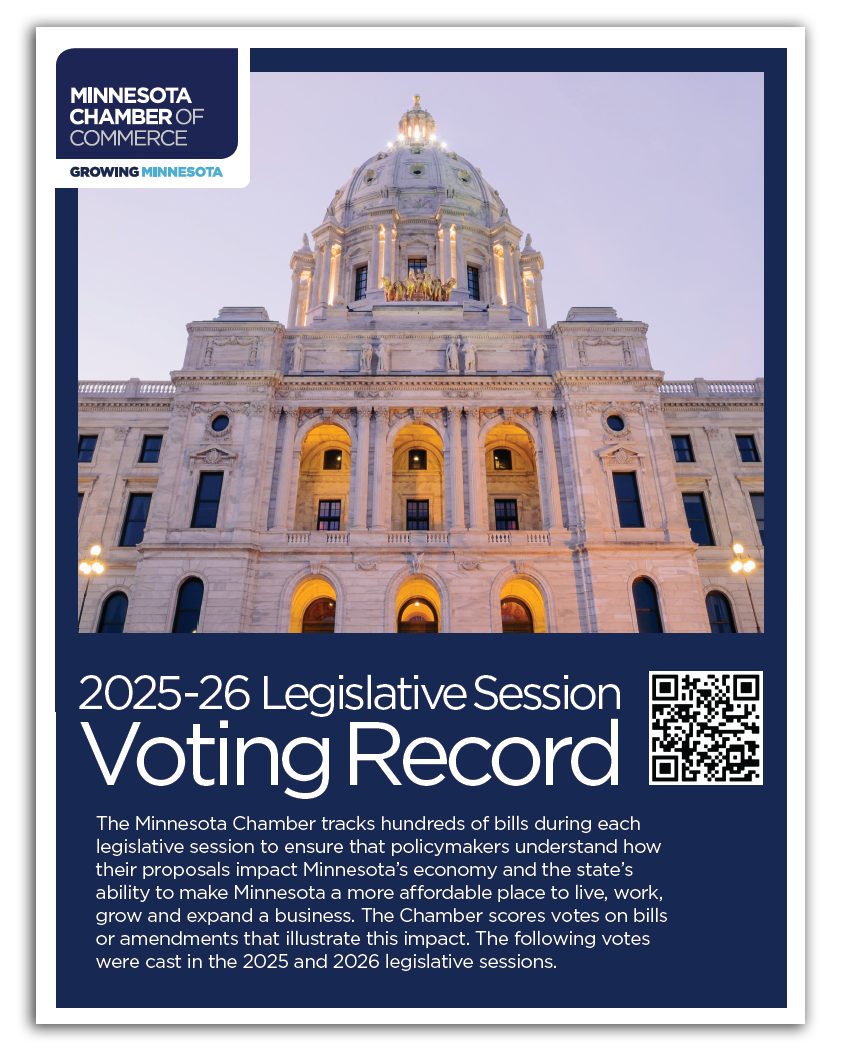
Download the 2025-2026 Legislative Voting Record
The Minnesota Chamber tracks hundreds of bills during each legislative session to ensure that policymakers understand how their proposals impact Minnesota’s economy and the state’s ability to make Minnesota a more affordable place to live, work, grow and expand a business. The Chamber scores votes on bills or amendments that illustrate this impact. The following votes were cast in the 2025-2026 legislative sessions.