
Streamlining Minnesota’s environmental permitting process: 2026 update
View the scorecard


Overview and key findings
In February 2024, the Minnesota Chamber Foundation released an in-depth report examining the efficiency and transparency of Minnesota’s environmental permitting system. This research, led by Barr Engineering, the Policy Navigation Group and Squire Patton Boggs, answered key questions about how long it takes to get an air or water permit in Minnesota, how Minnesota’s permitting timelines and processes compare to other states and what Minnesota can do to streamline its programs in air, water, wetlands and environmental review.
The study found that while Minnesota has areas of strength in its permitting system, businesses often face significantly longer wait times for environmental permits compared to other states. For instance, obtaining a federal individual air permit for construction in Minnesota took 1.5 to six times longer than in states like North Dakota, Iowa, Wisconsin, Illinois, Colorado, North Carolina and Tennessee. The report identified numerous areas for improvement to make Minnesota’s permitting and environmental review programs more streamlined, transparent, certain and collaborative while maintaining Minnesota’s commitment to protecting natural resources and public health.
Minnesota has a long legacy of protecting the natural environment and enabling investments to spur innovation and economic growth. Reforming and modernizing Minnesota’s environmental programs can position the state to build on its existing industry strengths and capitalize on emerging opportunities in energy and clean tech, food and ag innovation, mining, advanced manufacturing and life sciences.
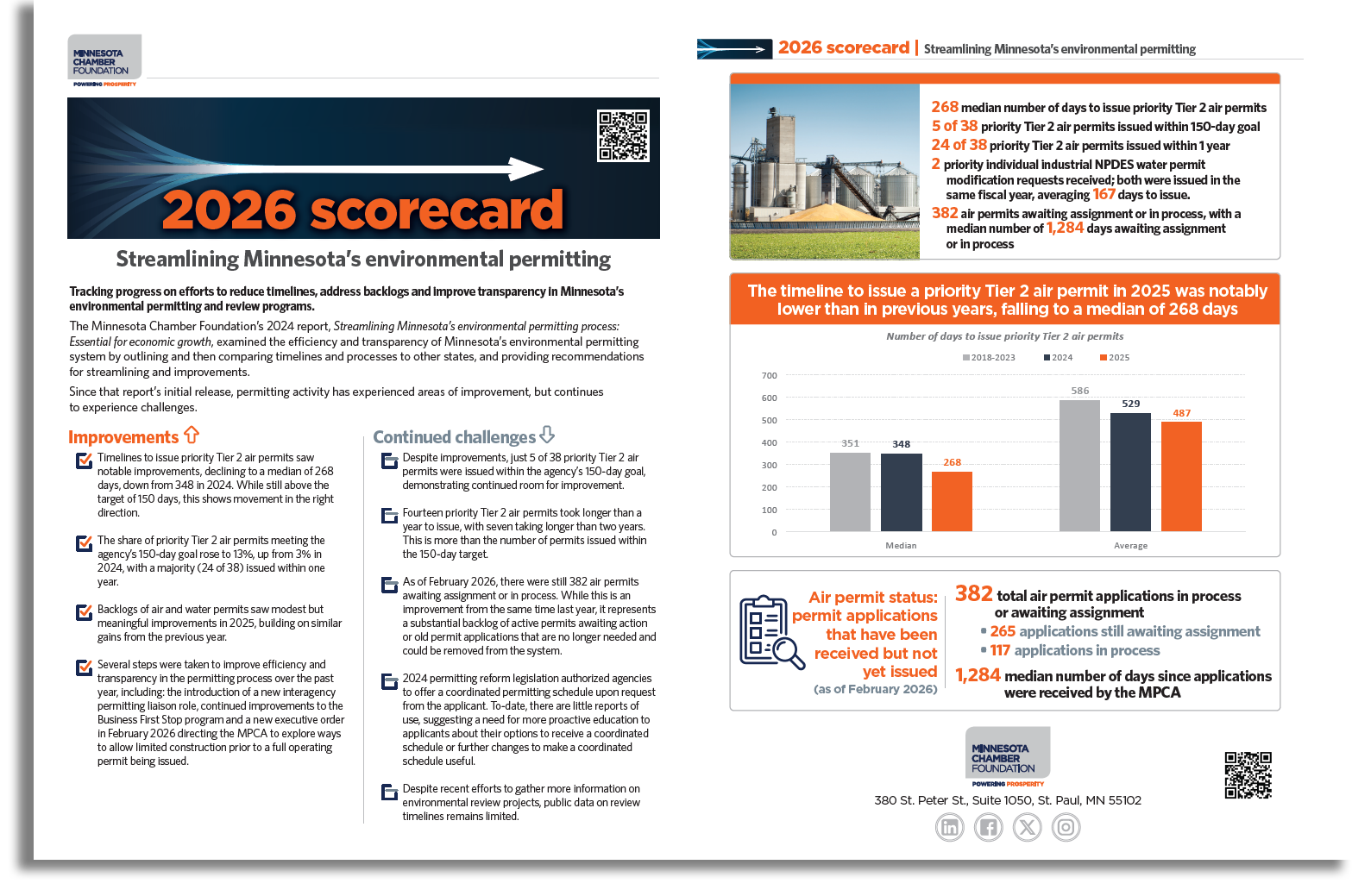
This annual scorecard looks at permitting activity over the past year to identify areas of progress and continued challenges. The findings reveal areas of promising improvements and continued challenges.
Improvements
- Timelines to issue priority Tier 2 air permits saw notable improvements, declining to a median of 268 days, down from 348 in 2024. While still above the target of 150 days, this shows movement in the right direction.
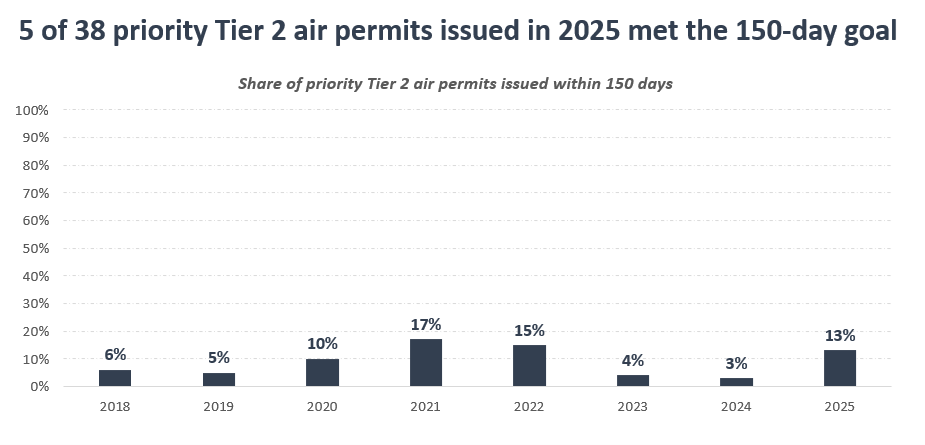
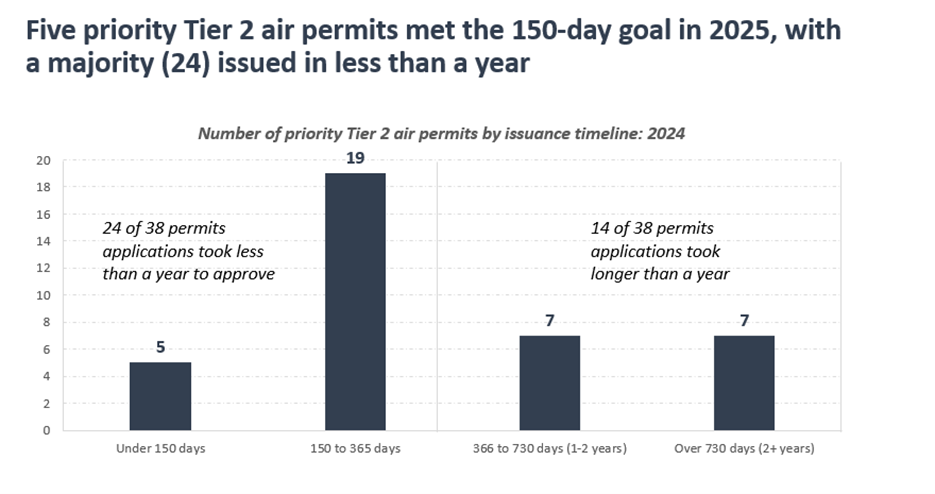
- The share of priority Tier 2 air permits meeting the agency’s 150-day goal rose to 13%, up from 3% in 2024, with a majority (24 of 38) issued within one year.
- Backlogs of air and water permits saw modest but meaningful reductions in 2025, building on similar improvements achieved in 2024.
- Several steps were taken to improve efficiency and transparency in the permitting process over the past year, including: the introduction of a new interagency permitting liaison role, continued improvements to the Business First Stop program and a new executive order in February 2026 directing the MPCA to explore ways to allow limited construction prior to a full operating permit being issued.
Continued challenges
- Despite improvements, just 5 of 38 priority Tier 2 air permits were issued within the agency’s 150-day goal, demonstrating continued room for efficiency gains.
- 14 priority Tier 2 air permits took longer than a year to issue, with seven taking longer than two years. This is more than the number of permits issued within the 150-day target.
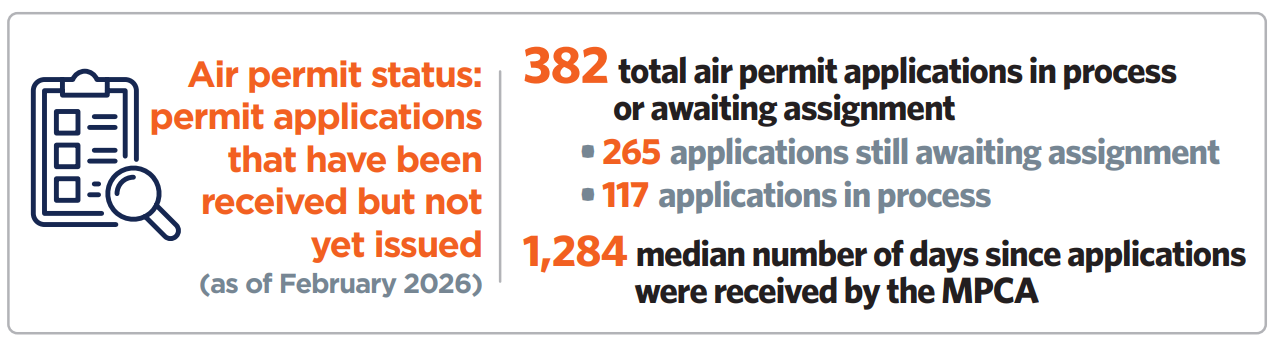
- As of February 2026, there were 382 air permits still in process or awaiting assignment to agency staff. A majority (265 of 382) are still awaiting assignment and have been in the system for a median of 1,419 days. While the number of unassigned permit applications has declined for two consecutive years, it represents a still-substantial backlog of active permits awaiting action or old permit applications that are no longer needed and could be removed from the system.
- 2024 permitting reform legislation authorized agencies to offer a coordinated permitting schedule upon request from the applicant. To-date, there are little reports of use, suggesting a need for more proactive education to applicants about their options to receive a coordinated schedule or further changes to make a coordinated schedule useful.
- Despite recent efforts to gather more information on environmental review projects, public data on review timelines remains limited.
Taking further steps to streamline Minnesota’s environmental permitting system remains a high priority as the role of permitting has grown in importance to business location and expansion decisions across the country. As the site selection publication Area Development notes in its 2025 Best States for Business report:
“We also continue to elevate the importance of water access, permitting speed, and site readiness –
all increasingly make-or-break factors in large capital investment decisions.” They go on to say,
“For many corporate expansions, the question is no longer where to go – it’s who can move fast enough.
In 2025, speed to market isn’t just an advantage. It’s the baseline.
As project timelines compress and permitting hurdles grow more complex,
states that offer ready-to-go sites, transparent permitting paths, and
aligned local coordination are separating from the pack.” – Area Development
By continuing to streamline the state’s permitting process and creating strong coordination with project applicants, Minnesota can better compete for investments that will drive job growth, wages and economic growth in the coming years.
This updated research provides high-level context for policymakers, regulators, and other stakeholders seeking to help Minnesota’s regulatory programs and economy perform to their full potential.
Back to top
Tracking progress on efficiency and transparency in Minnesota’s environmental permitting system
Recommendation: Reduce the time it takes to issue priority Tier 2 air and water permits, bringing average and median timeframes closer to the agency’s 150-day goal.
2025 progress
Minnesota made notable progress in reducing timelines to issue priority Tier 2 air permits in 2025. Despite gains, however, only 5 of 38 permits met the agency’s 150-day goal, revealing continued room for efficiency improvements.
Background
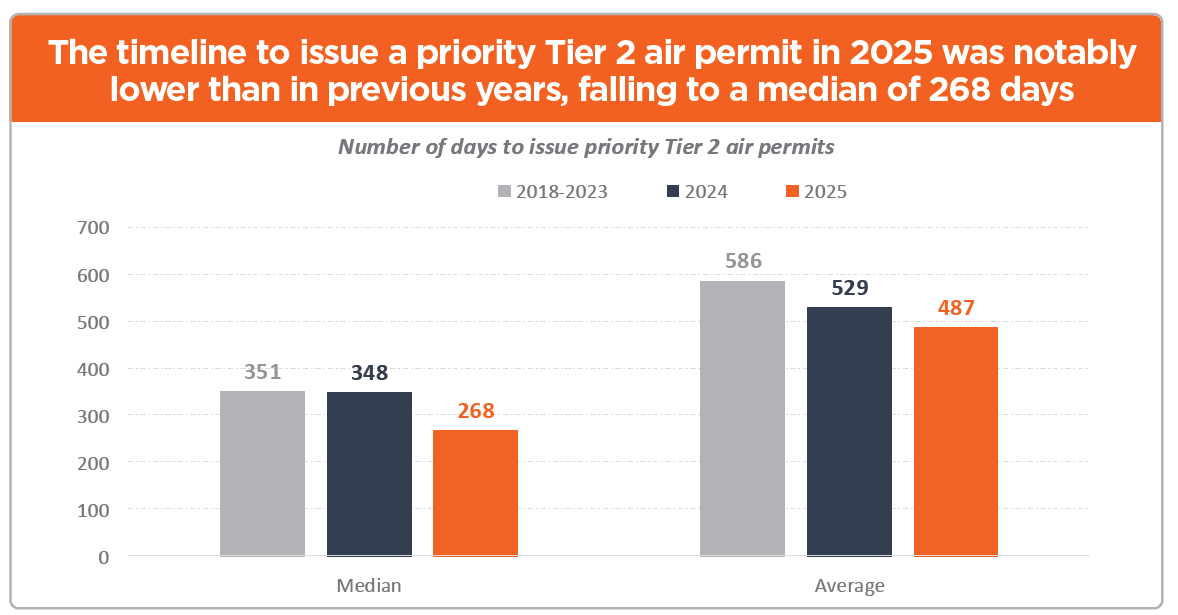
The Minnesota Chamber Foundation’s 2024 report showed a stark divide in permit review timelines between Tier 1 and Tier 2 air and water permits. While Tier 1 permits are typically issued within a month of the application being submitted, Tier 2 permits often take a year or longer to be reviewed and issued by the Minnesota Pollution Control Agency (MPCA). This is particularly problematic for “priority” permit applications in which a permit is needed for construction activity to take place at the facility. From 2018-2023, the average duration to issue a priority Tier 2 air permit was 586 days, and the average duration to issue a new priority Tier 2 industrial water permit was 476 days. Some projects take much longer, exceeding 1,000 days to issue, reissue or modify a permit. Reducing permitting timelines for priority Tier 2 air and water permits would make Minnesota more competitive for large economic development investments.
Assessment of 2025 outcomes
Priority Tier 2 air permits:
The data show improvements in the typical issuance timelines of priority Tier 2 air permits in 2025. The median timeframe to issue all priority Tier 2 air permits was 268 days, down from 348 days in 2024 and 352 days in the previous 5-year period from 2018-2023. Additionally, the share of permits meeting the MPCA’s 150-day goal rose to 13% and a majority 24 of 38 permits were issued within one year. This marks an improvement from previous years. Continued challenges remain as well. While typical timeliness improved, only five of 38 (13%) priority Tier 2 air permits were issued within the 150-day goal, and seven permits took longer than two years to issue. This demonstrates a continued need for efficiency improvements to ensure Minnesota can retain and attract critical business investments.
Priority Tier 2 water permits:
Priority Tier 2 individual industrial water permits faced similar outcomes, though the MPCA receives far fewer applications of this kind than it does priority Tier 2 air permits. Since fiscal year 2018, the MPCA received just 19 priority Tier 2 water permit applications and received only two in fiscal year 2025. Of the 19 permits applications received since 2018, 15 have been issued, averaging 340 days from initial receipt to final issuance. Additionally, the two received in fiscal year 2025 were both issued in the same year – one being a major amendment that was issued in 305 days and the other a minor amendment issued in just 29 days. This demonstrates progress toward achieving faster permitting reviews. Still of concern, however, are four pending applications that have been under review for an average of 1,194 days.
Recommendation: State regulators should address backlogs of permit renewals and minor facility changes for air and water permits.
2025 progress
Backlogs of permit reissuances and modifications improved again in 2025 for the second consecutive year. However, non-priority Tier 2 air and water permits continue to face years-long review times, and a high number of permits are awaiting assignment or past their permit term.
Background
Previous research from the Minnesota Chamber Foundation found a significant backlog of air and water permits that had been in process for years or were still waiting to be assigned to agency staff. Much of these backlogs are related to permit reissuances or changes to existing permits. This backlog results in long timelines to issue or reissue non-priority Tier 2 permits. For example, findings showed that non-priority Tier 2 air permits took an average of 1,295 days to be issued, with Title V permit renewals averaging nearly 1,500 days.
Additionally, as of November 6, 2023: MPCA had approximately 371 air permit applications awaiting assignment; approximately 25% (91 of 371) had been awaiting assignment for less than 365 days; the remainder (280 of 371) had been awaiting assignment for anywhere from 1-30 years.
Individual industrial water permits (NPDES/SDS permits) faced deep backlogs as well. Of the 226 NPDES/SDS permits currently administered by the MPCA, 152 were administratively continued (i.e. past the expiration date, but still in effect) as of the end of Q3 2023. The average amount of time these permits are administratively continued was 6.5 years, with the longest being 23 years.
Addressing these backlogs could allow hundreds of facilities in Minnesota to operate with an up-to-date air or water permit, providing greater assurance to businesses and communities. Further, improving the process by which permit applications are assigned to staff writers could improve efficiency without reducing any thoroughness of the review.
Assessment of 2025 outcomes
Non-priority Tier 2 air permits:
The MPCA issued 81 non-priority Tier 2 air permits in 2025. These permits were issued in a median of 1,081 days, up from 784 days in 2024 and 887 days in the previous five-year period. Nearly half (36 of 81) of these permits were federal individual reissuances, which often face the longest timelines since the business can continue operating under their existing permit while they await its reissuance. There may be mixed implications regarding the increase in issuance timelines over the past year. One reason may be that the agency is addressing backlogs of older permit applications, in which case the average issuance timelines will be higher but reflect positive movement in reducing years-old permit renewals and modifications. However, a deeper look shows that more recent non-priority Tier 2 permit applications also continue to face long timelines. Of 122 non-priority Tier 2 applications received by the MPCA within the past two years, just 35 have been issued to-date, with 71% still awaiting assignment or in process. Since these non-priority permit applications aren’t tied to projects involving construction activity, they may pose less impact to the applicant and local economy. However, reducing timelines and addressing backlogs of these permits would still improve the overall efficiency of the system and ensure facilities have up-to-date permits.
Air permits in process or awaiting assignment:
As of February 2026, there were 382 air permit applications still awaiting assignment or in process, down from 441 in February of 2025. Of these, 265 are listed as still awaiting staff assignment in the MPCA Air Permits Received dashboard. The remaining 117 are in process. These permits applications have been awaiting assignment or in process for a median of 1,284 days since their submission.
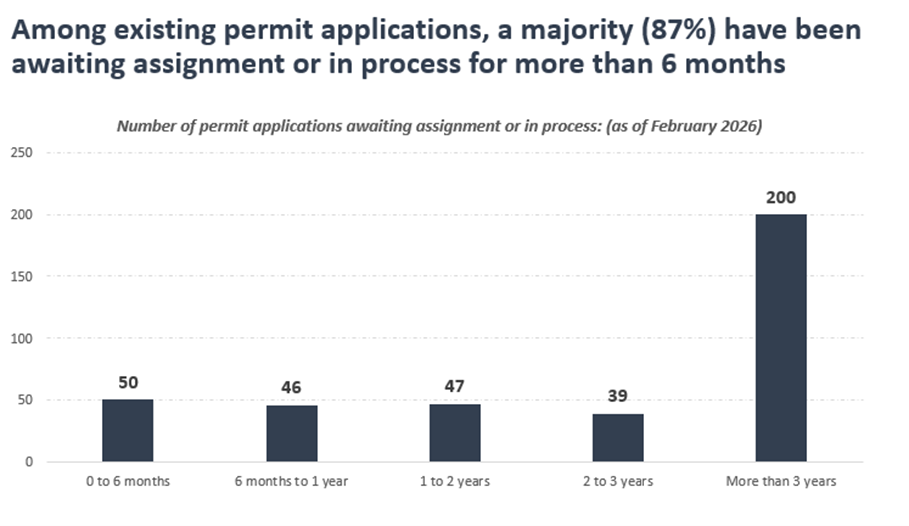
Consistent with past research, this review found that a significant number of permits remained unassigned to MPCA staff. According to data from the MPCA Air Permits Received dashboard, 265 of the 382 applications (69%) were still awaiting assignment as of February 2026, down from 326 a year prior and 371 at the end of 2023. This demonstrates continued progress in reducing air permit backlogs compared to previous years. But while the number of permits awaiting assignment has declined, the length of time to assign permits to agency staff and complete reviews remains a concern. 87% of these applications have been awaiting assignment or in process for longer than six months, and over half (52%) have been in the system for longer than three years.
Individual industrial NPDES water permits:
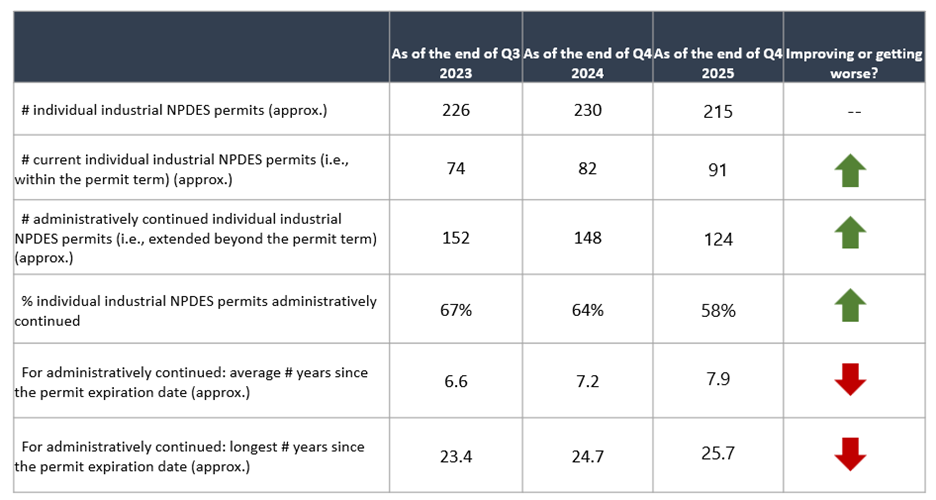
Backlogs of individual industrial NPDES permits continued to improve in 2025, compared to previous years. The number of businesses operating with an up-to-date individual industrial permit (i.e. within their permit term) increased to 91, up from 82 the previous year and 74 in 2023. Similarly, the number of administratively continued permits (i.e. extended beyond the permit term) decreased slightly from 148 to 124. As of the end of Q4 2025, 58% of all individual industrial NPDES water permits in Minnesota were administratively continued, down from 64% in 2024 and 67% in 2023.
Despite this improvement, there remains a substantial number of administratively continued permits that should be addressed. The average number of years that those permits were past the expiration date increased to 7.9 years.
Recommendation: Minnesota should improve transparency, certainty and collaboration throughout Minnesota’s permitting and environmental review programs.
2025 progress
Actions taken over the last year create a mix of both promising improvements and further burdens to Minnesota’s environmental permitting and review programs.
Background
The Minnesota Chamber Foundation’s 2024 report on environmental permitting identified numerous opportunities to improve overall transparency and certainty in the state’s air, water, wetlands and environmental review programs. Some of these programs, such as environmental review, lack reliable and accessible data to track project timelines and identify opportunities to improve processes. Other programs, like air and water permitting, had mixed results in providing permit applicants with expected timelines and milestones throughout the process. Minnesota’s environmental permitting process can be complex, requiring adequate collaboration and support for applicants. The report argued that implementing reforms could improve businesses’ ability to predict and plan capital investment projects, as well as better understand their regulatory compliance obligations.
Assessment of 2025 outcomes
Several steps were taken in 2025 that may increase support and transparency for permit applicants or project proposers. Some actions taken over the past year include:
- Minnesota has taken steps to make its permitting process more navigable and responsive for businesses by introducing a new Interagency Permitting Liaison role within Minnesota Business First Stop. This position is designed to serve as a central point of contact for companies, helping them understand requirements, coordinate across agencies and move projects forward more efficiently. The role aims to bring greater predictability to the permitting process, which could help Minnesota better compete for business investment projects in coming years.
- In addition, Governor Walz issued an executive order on February 13, 2026, directing the Minnesota Pollution Control Agency (MPCA) to explore options to allow limited early construction before full operational permits are issued. This change builds on recommendations from the Minnesota Chamber Foundation’s 2024 report, which found that many states use a two-stage process to separate construction and operating permits. This is intended to take into account the time-sensitive realities of construction schedules that can significantly impact costs and speed-to-market for business investment decisions.
However, recent steps to improve permitting efficiency and transparency are still early in their adoption. Evidence suggests that some of the new tools and directives have not yet materialized into action. For example:
- State policymakers passed legislation in 2024 requiring state agencies to provide coordinated project plans upon request. This policy is intended to create greater transparency for project proposers, allowing them to better plan and predict steps in the review process. A coordinated project plan defines agency roles, public meeting schedules and deadlines for environmental reviews and permits, ensuring compliance with state requirements. (Minn. Session Law – 2024, Regular Session). However, as of early 2026, few projects have utilized this new tool, suggesting a potential need for more education to project proposers.
- Similarly, the Environmental Quality Board (EQB) introduced a new process in 2024 to begin surveying Responsible Government Units (RGUs) to gather more information on environmental review projects. While this is a positive first step, public data on environmental review projects remains limited. Further commitments to track and make public information on review timelines could add predictability and transparency for businesses.
- Further, anecdotal evidence from outreach to businesses and economic development professionals shows that real and perceived challenges in the state’s environmental permitting system continue to have negative impacts on new business investment activity in the state. Further outreach and collaboration with businesses, site selectors and economic developers can add more certainty on permitting timelines and processes.
Back to top
Actionable strategies
The Minnesota Chamber Foundation’s 2024 report identified 18 key recommendations to streamline the state’s environmental permitting system. While some progress has been made over the past year, we encourage policymakers and regulators to explore these ideas for further improvements.
See full recommendations in the original report here: https://www.mnchamber.com/minnesota-chamber-foundation/streamlining-minnesotas-environmental-permitting-process-actionable
Air permitting
- Review and revise approach to completeness evaluations.
- Provide additional support for permit applicants.
- Use a separate construction and operating permit program.
- Review and revise expedited permitting options.
- Encourage applicants to use Tier 1 permitting options when possible or consider expanding the existing registration and capped permitting programs.
- Continue to expand online air permitting services, while soliciting and acting upon user feedback to improve user experience and reliability.
- Review and potentially address the permitting queue of “old” air permit applications (applications that have not been assigned but were received more than 365 days ago).
- Make air permitting data more accessible to permittees and the public.
Water permitting
- Further prioritize commitment to permit issuance timelines.
- Find opportunities for the MPCA to improve process efficiency.
- Develop an online resource for water permitting data.
- Reduce regulatory complexity.
Wetlands
- Complete the 404 assumption process.
- Expand the BWSR annual LGU report to include timing on completeness review and decisions.
- Revise Minnesota Statute 15.99 Subdivision 3(f) to be clear about the maximum number of times a RGU can extend the initial 60-day decision timeframe for WCA determinations.
Environmental Review
- Improve transparency of Environmental Review timelines and outcomes.
- Narrow the focus on the required EAW content.
- Align the mandatory EIS Process with NEPA.
Back to top
About the Minnesota Chamber Foundation
The Minnesota Chamber Foundation is the state’s leading private-sector resource on the performance of Minnesota’s economy. Its first economic research— Minnesota: 2030 was released in 2021 as the state was emerging from the pandemic. This flagship report details the state’s economic assets and challenges, and provides dozens of recommendations and strategies to accelerate Minnesota’s growth leading to 2030.
Additional reports from the Foundation detail the benefits of immigrants to the state’s economy; the state of entrepreneurship and consistent updates to our original Minnesota: 2030 report. Looking ahead, the Foundation will produce a piece on migration trends in Minnesota. Domestic migration and immigration are critical factors that impact the growth of the economy, but are often misrepresented or misunderstood.
The Foundation’s work has become a trusted resource for the media, policymakers and business leaders. The data and research help inform business decisions and policy solutions.
The Foundation is also home to a nation-leading workforce inclusion initiative. Designed to be a practical approach to accommodate all dimensions of diversity across Minnesota, our efforts have gained tremendous momentum with small and mid-size businesses and those located in Greater Minnesota. These companies comprise the majority of Minnesota workers, and business leaders understand both the economic and moral imperative to creating inclusive work environments.
In addition, our partnership with local chambers of commerce through our Business Education Network continues to grow, connecting students to high demand careers in their communities.
To learn more about the Foundation’s work, please contact the staff listed on the back of this report.
We welcome your engagement and your investment in our efforts.