
Minnesota’s economic imperative: A blueprint for growth
View the full report



Executive summary
Growing the economy creates more opportunity and prosperity for every Minnesotan
Minnesota faces an imperative to accelerate economic growth in the coming years. Robust private sector growth supports more jobs, higher incomes, better public services and infrastructure, stronger business investment and ensures quality of life throughout the state.
These are shared priorities that strengthen the foundation of Minnesota’s long-term prosperity. Minnesota’s economy is resilient, but it has lagged national growth over the past decade. This gap is reflected across nearly every major macroeconomic indicator – from labor force and job growth to household income, productivity and gross domestic product.
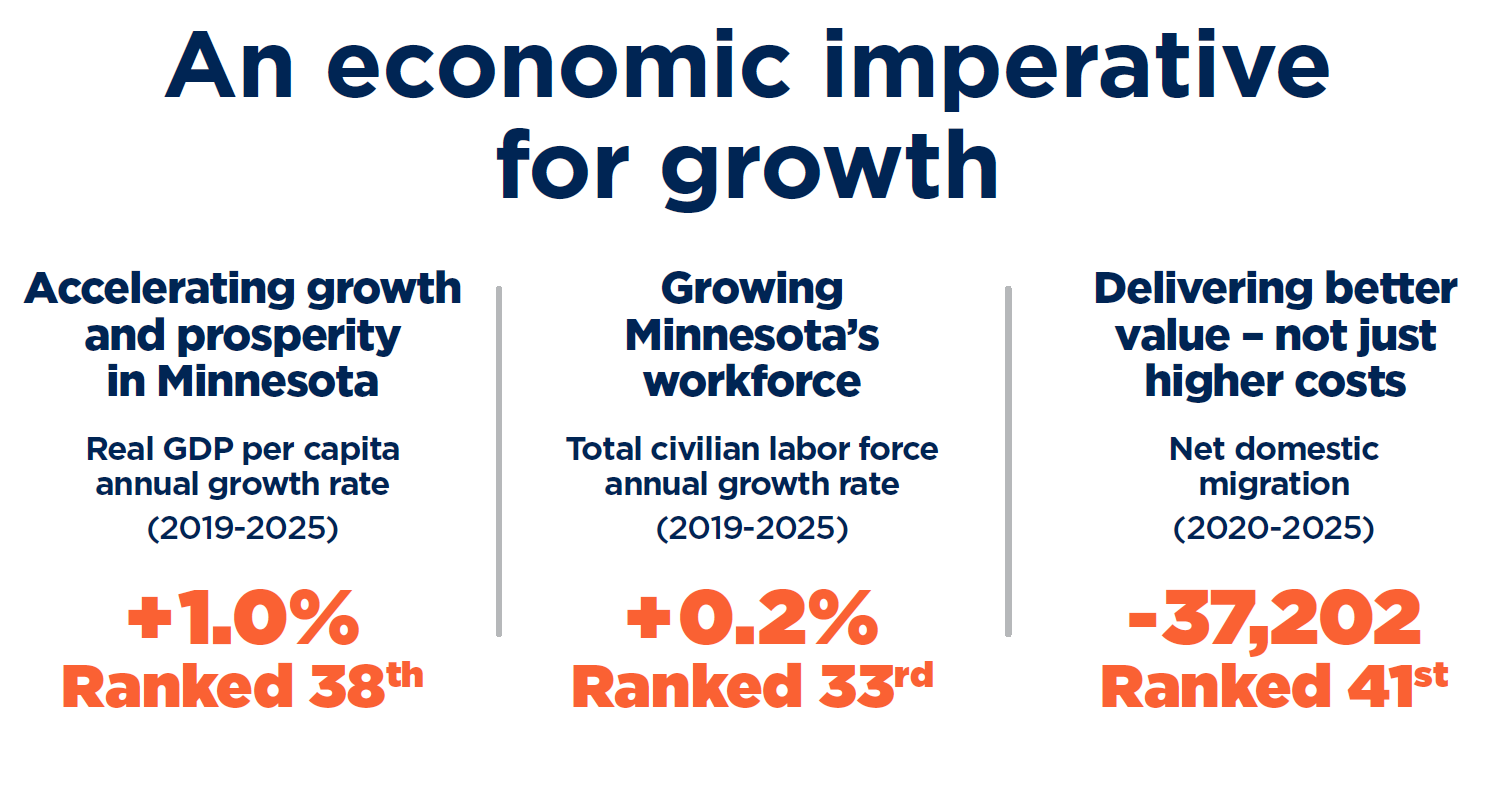
The Minnesota Chamber Foundation’s 2026 Business Benchmarks report highlighted three key indicators that underscore this challenge. From 2019 to 2025, Minnesota ranked 38th in GDP per capita growth, 33rd in labor force growth and 41st in net domestic migration. This means Minnesota has assets for growth but isn’t turning them into results.
Minnesota’s economy is not in decline. It continues to grow, supported by strong underlying fundamentals. Boosting Minnesota’s economic growth would create real benefits for people across the state.
Stronger household finances: Per capita growth allows incomes to outpace inflation, improving purchasing power and financial well-being. When incomes grow faster than prices, people can afford more, which matters as the cost-of-living rises.
Career advancement: Faster growth means more high-quality jobs across different industries. This directly benefits Minnesotans who are entering the workforce or seeking new career opportunities.
Innovation and entrepreneurship: A growing economy makes it easier to start and grow businesses, bringing new ideas and investment. Minnesota’s homegrown economy relies on entrepreneurs who start new ventures and grow their business in the state.
Growing local communities: Communities thrive when they are adding new residents, workers and businesses. Local growth and investment boosts confidence for residents that their community is moving in the right direction.
Fiscal stability: Stronger growth expands the tax base, easing long-term budget pressure for the state and local communities, which is especially important with budget deficits in the coming years.
Back to top
Challenges and opportunities ahead
Minnesota’s economy has both challenges and opportunities ahead. The state’s population growth is slowing, and the workforce is getting older. Over the next decade, the workforce is expected to grow by just 55,000 people – an average annual growth rate of just 0.2%.
This means that Minnesota must increase productivity in the existing workforce, helping businesses invest and innovate, and boost employee skills. Further, while Minnesota can’t reverse long-term demographic trends, it can meet future needs by bringing more people into the workforce and attracting and keeping more workers in the state.
These challenges are not easy to solve, but Minnesota is starting from a position of strength. States around the country are facing similar population and workforce challenges. Minnesota’s unique strengths could position it to be a leader in an evolving economy.
Turning these strengths into results will take deliberate action. Growth must be a shared priority among business leaders, policymakers, educators and communities – even if there are different views on how to achieve it.
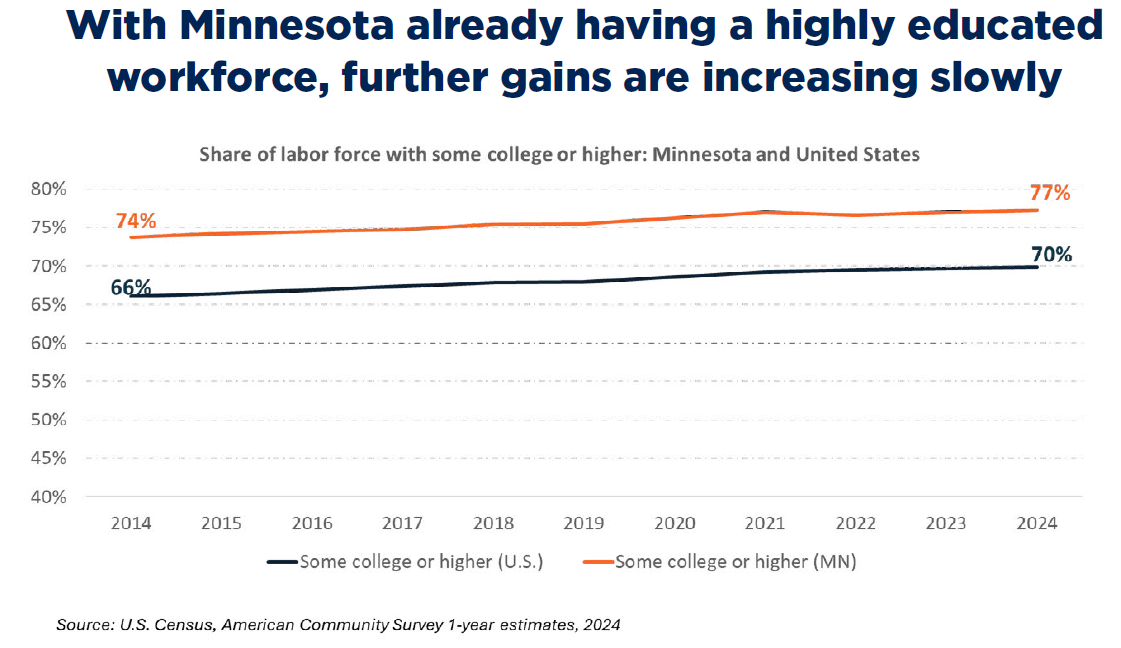
The state has one of the most educated workforces in the nation, with nearly three out of four adults in the labor force having some postsecondary education. It has a diverse private sector economy, with companies driving innovations in areas like health and medical technology, food and agriculture, water and energy technologies, minerals and mining, advanced manufacturing and leading consumer products that are exported to markets around the world.
Taken together, this talent, innovation and resource base gives Minnesota a strong foundation for growth. If fully leveraged, these strengths can help the state compete, grow and create lasting prosperity for the next generation.
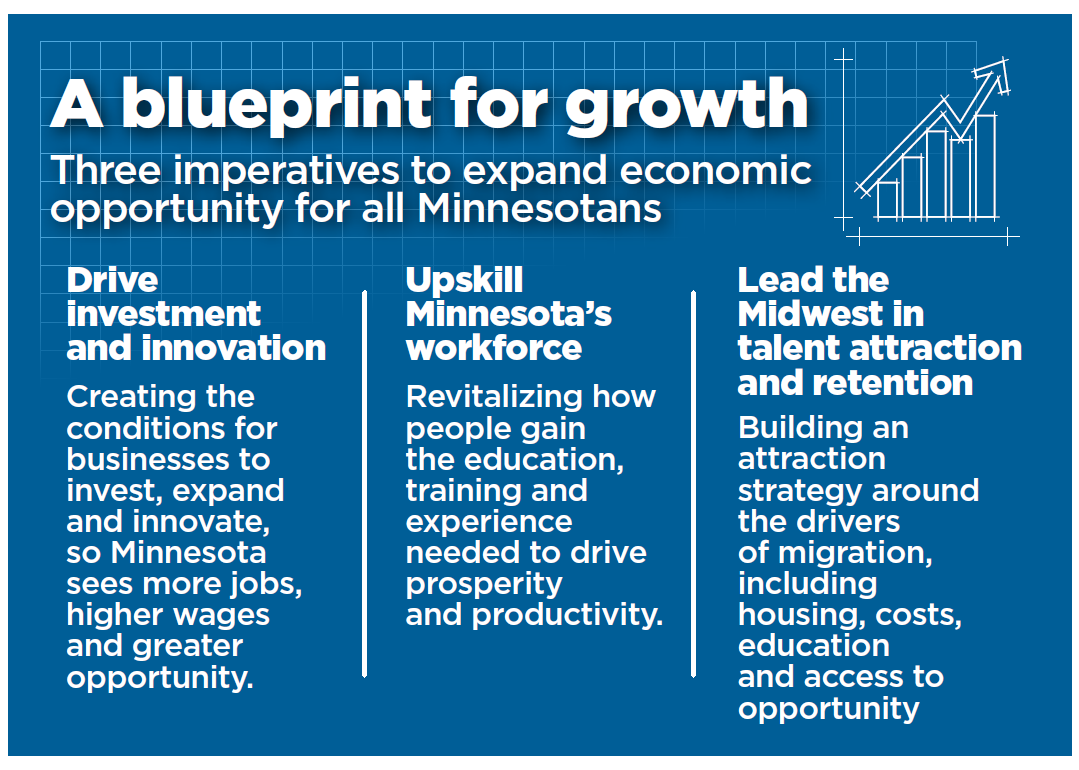
This report lays out a blueprint to focus attention and action around three key imperatives for growth in the state’s economy. This is a starting point intended to spur conversation, ideas and action in the months and years to come.
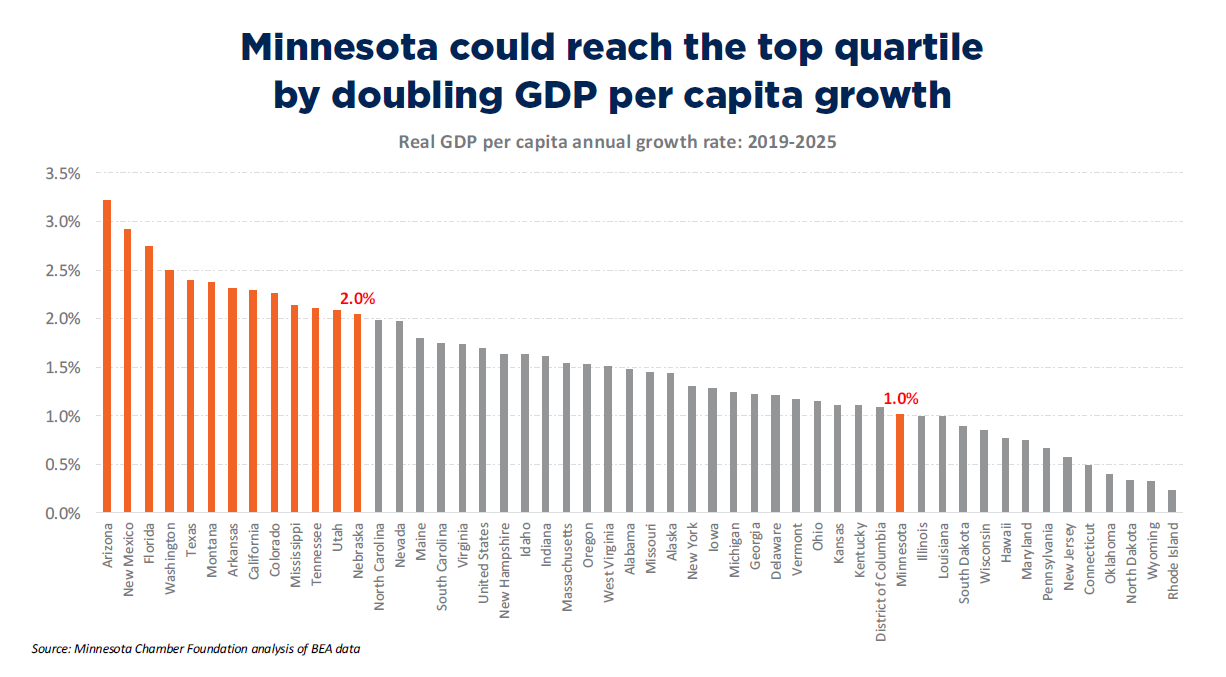
Doubling per capita economic growth would move Minnesota into the top quartile of states and create a more prosperous economy for future generations.
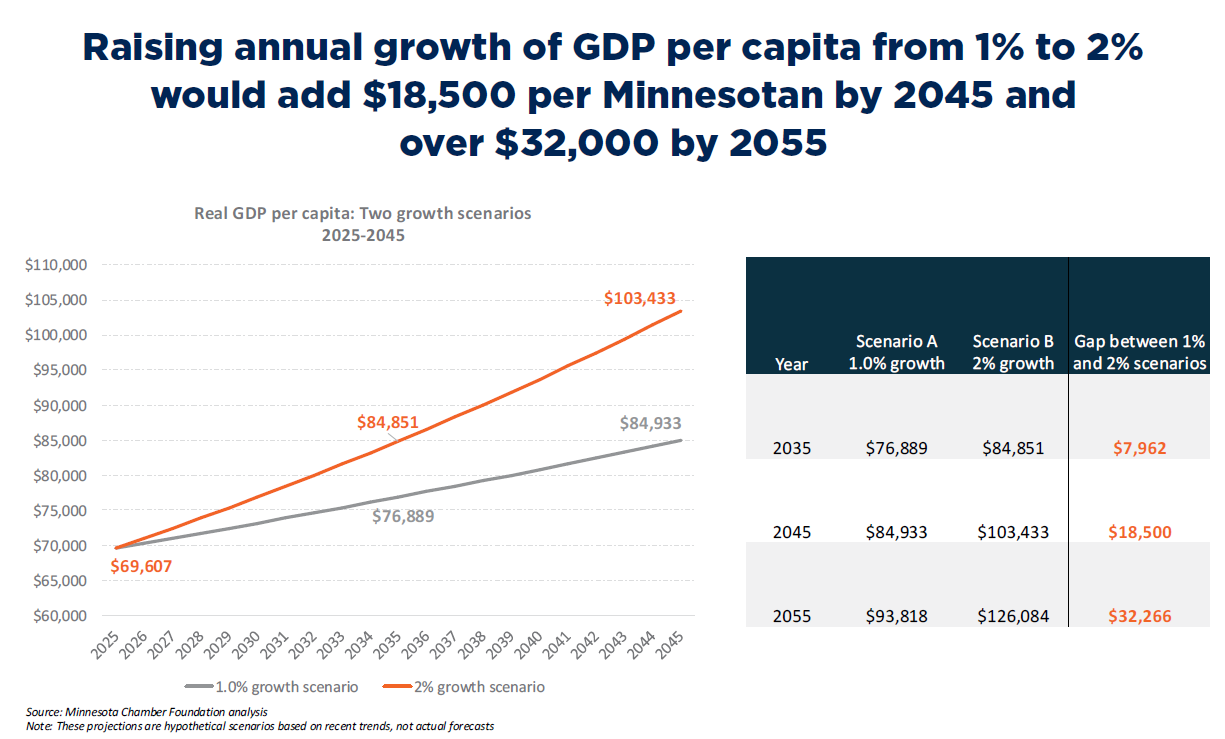
If Minnesota had grown GDP per capita at 2% annually instead of 1% since 2019, output per person would be roughly $4,000 higher today, putting Minnesota into the top quartile of states. Over time, the impact compounds significantly. At current trends, the difference between 1% and 2% annual growth amounts to nearly $18,500 per person within twenty years and more than $32,000 per person over 30 years. This means that children born in 2026 would start their careers in a substantially more prosperous economy, increasing their opportunities and quality of life.
Minnesotans today have an obligation to invest in future prosperity. A goal to double per capita economic growth over the next decade – while aspirational – is entirely feasible and would directly improve the lives of Minnesotans.
The question remains, what can we do to get there?
Back to top
A blueprint for economic growth
Growing the state’s economy will require focused attention on three key priorities.
First, Minnesota needs to unlock more private sector investments in the state’s economy. The economy grows when businesses invest in new locations, expansions, innovations and tools to boost the productivity of their employees. While Minnesota has the strengths to capture investments in a range of industries, the data show investments have stagnated in the first half of the decade.
Second, Minnesota must advance an all-in strategy to invest in the skills and capabilities of its workforce. This will require a shift in focus to think about how people develop their skills beyond the classroom. Creating effective collaborations between employers, workers and training providers can build human capital and drive productivity in coming years. Third, Minnesota can’t grow through productivity alone. The state must find ways to better retain and attract talent. This will require strategies that address underlying drivers of migration – housing, higher ed, tax policies and immigration – to move the needle on growing Minnesota’s population and workforce.
IMPERATIVE:
Drive investment and innovation
Minnesota has a strong base of businesses, but the pace of new investment and innovation has slowed in recent years, and that matters for both employers and employees.
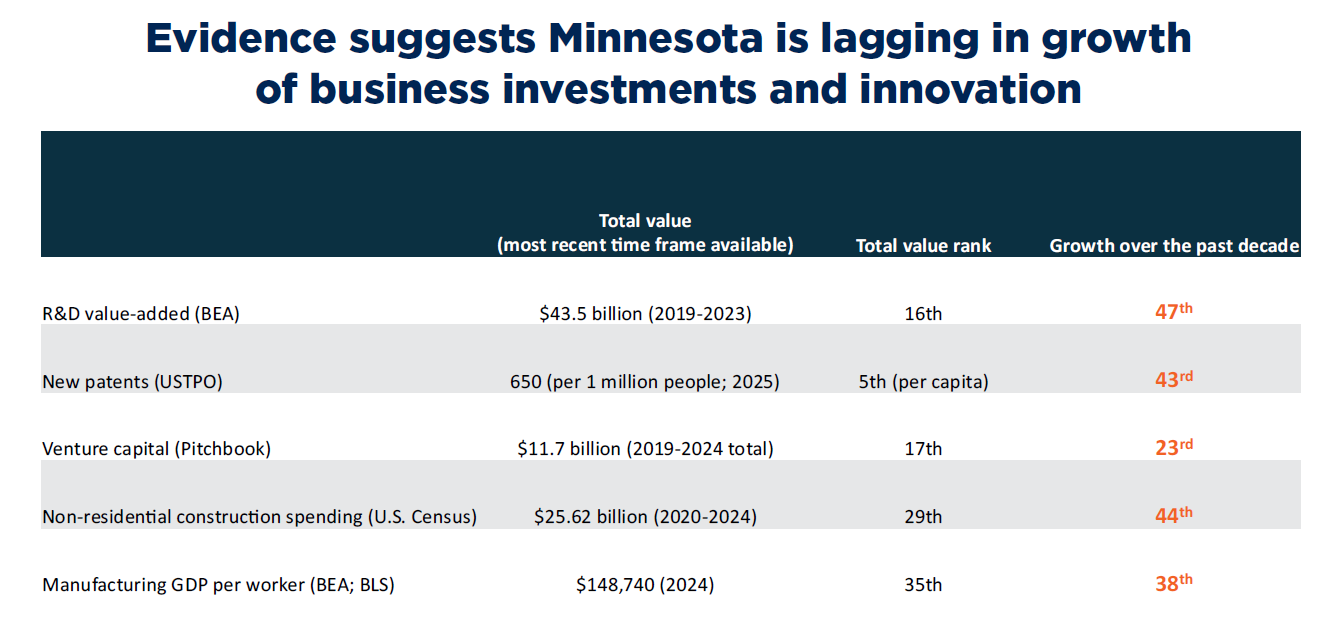
Minnesota ranks 5th in total patents per capita, highlighting the state’s strong history of innovation. But it ranks 43rd in growth in new patents since 2015, illustrating that it’s not keeping up with other states in developing new ideas. For businesses, that can mean falling behind competitors. For workers, it can mean fewer new industries and opportunities.
The state ranks 16th in total research and development (R&D) output but 47th in growth, meaning Minnesota isn’t expanding on its strong foundation. That limits future breakthroughs, business expansions and high-paying jobs. Likewise, Minnesota ranks 45th in growth of non-residential construction spending and 47th in startup job creation.
The state also has competitive advantages and emerging opportunities that could be better leveraged, from investments in advanced sectors to scaling new and small businesses. Unlocking this potential will require a reset in how Minnesota welcomes and enables new investments.
RECOMMENDATION:
Develop a clear economic vision that aligns policy and decision-making.
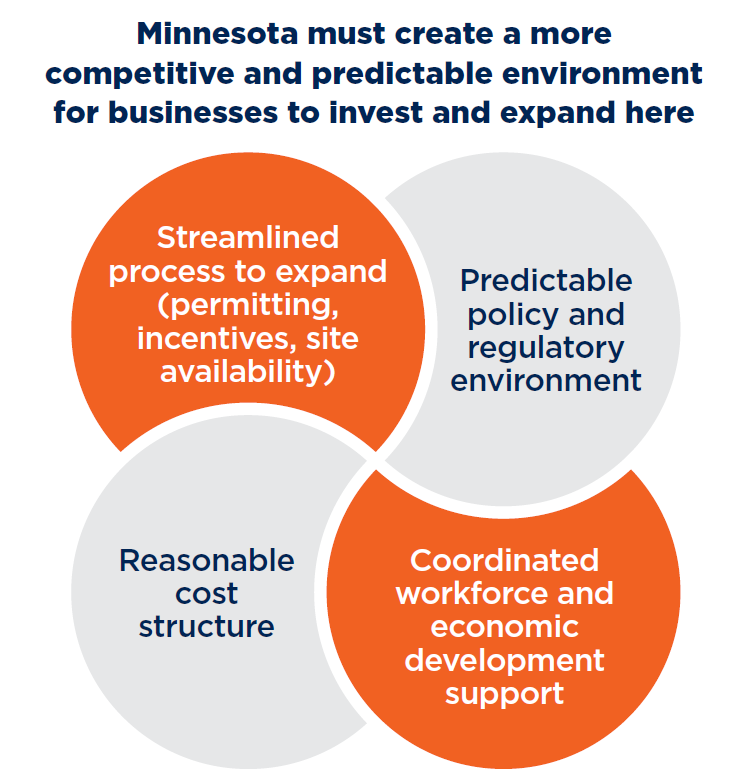
Minnesota needs a clear, consistent plan for economic growth, so businesses know what to expect when they consider investing here. Today, policies are often disconnected, send mixed signals and create uncertainty, which can deter long-term commitments. Stronger alignment – guided by state leadership and informed by business input – would encourage growth and attract investment.
RECOMMENDATION:
Streamline the process for business expansion and attraction.
The state should make it faster, more coordinated and more predictable for businesses to move projects from idea to reality. Improving permitting timelines, simplifying incentive programs, expanding shovel-ready sites and better aligning workforce training with project needs would remove these barriers. Businesses would have greater certainty, lower costs and the ability to move quickly in a competitive environment, bringing new jobs and local investment into communities.
RECOMMENDATION:
Improve long-term cost competitiveness.
Minnesota should update its tax structure to better compete with other states, while maintaining a stable budget. Today’s system is marked by high tax rates and a series of piecemeal policy changes, which make it harder for businesses to expand or invest, or choose Minnesota over other locations. A comprehensive review of the system would help identify more effective, long-term solutions. Pairing that with a focus on policies that expand the economic base would attract more investment and business expansion and create more opportunity across the state.
RECOMMENDATION:
Strengthen sector-based economic development strategies.
Minnesota should build on its existing strengths by more intentionally focusing on the industries where it has a competitive edge. This means aligning messaging, incentives and programming around high-growth sectors that drive productivity and prosperity. A more coordinated, sector-driven approach would help the state better compete for large-scale investments, attract new businesses and maximize regional strengths.
RECOMMENDATION:
Expand support for startups and small business growth.
While Minnesota has made progress in building its entrepreneurial ecosystem, more work is needed to help businesses scale. Enhancing access to capital, technical assistance and growth-oriented resources can ensure startups not only launch in Minnesota but expand there as well.
IMPERATIVE:
Upskill Minnesota’s workforce
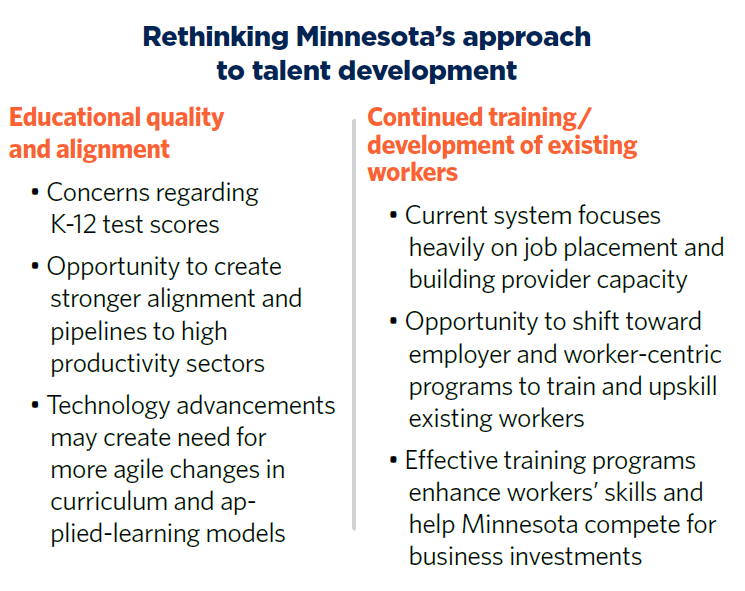
Increasing Minnesota’s economic growth potential will depend on continuing to build the skills and capabilities of the workforce. Part of this is driven by demographic necessity: the number of workers in the state is expected to grow very slowly. That means future growth can’t rely on adding more people – it has to come from helping each worker produce more and earn more.
This is especially important for businesses, which will face tighter labor markets and need more skilled workers to grow and compete. For Minnesotans, better skills translate directly into better job opportunities, higher wages and greater long-term financial stability. At the same time, rapid changes in technology – especially artificial intelligence – are reshaping the skills needed across many jobs. This requires faster and more flexible approaches to training and reskilling than in the past.
RECOMMENDATION:
Shift to an employer-centered workforce system focused on talent development.
Minnesota should modernize its workforce system to better match today’s economic reality – where a workforce is growing slowly and the demand for skills and productivity is rising. Today’s system isn’t always aligned with what employers need or focused on measurable results. Updating the system includes improving transparency and accountability, expanding employer-driven training programs and rebalancing resources toward initiatives that deliver measurable outcomes. A more flexible, skills-focused system – supported by modernized incentives and sector-based training – would help Minnesota keep pace with new technologies and ensure its workforce is ready for the jobs of today and the future.
RECOMMENDATION:
Strengthen business–education partnerships.
Minnesota should strengthen connections between employers, schools and training providers to better prepare people for good jobs. There is often a gap between what students learn and the skills businesses need, especially as technology and industries change quickly. Closer collaboration can help translate real-world demands – like skills in AI and advanced technology – into relevant training, internships and apprenticeships. This means a stronger pipeline of job-ready talent and clearer pathways into good careers. Expanding proven models that connect business and education networks can help build a more responsive and connected talent pipeline across the state.
IMPERATIVE:
Advance a statewide initiative to lead the Midwest in talent retention and attraction
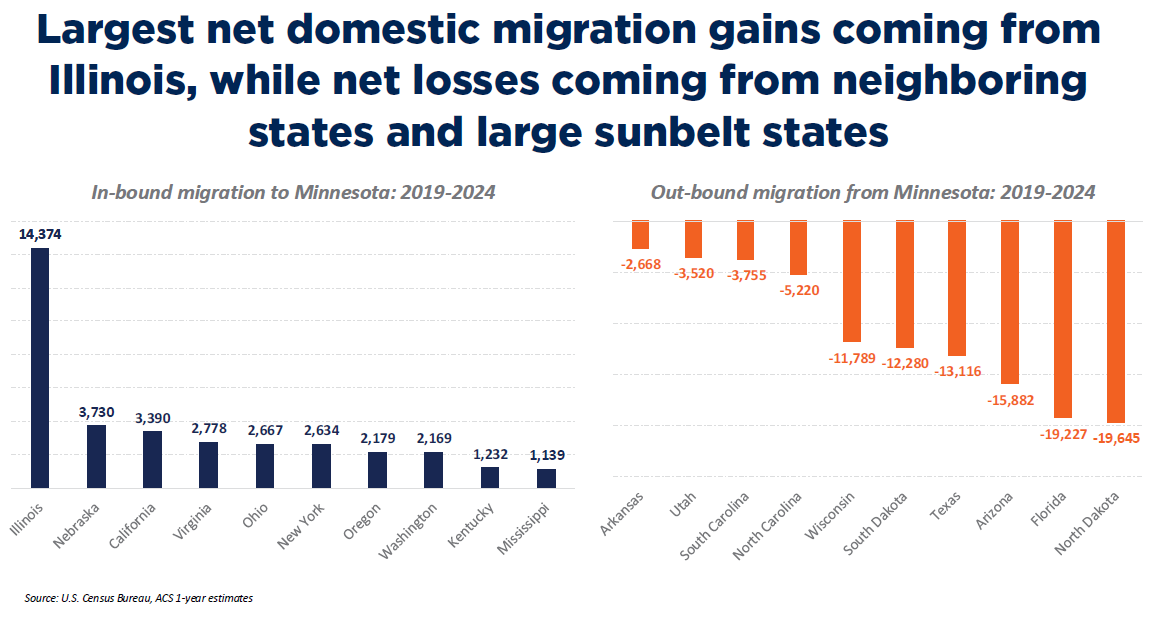
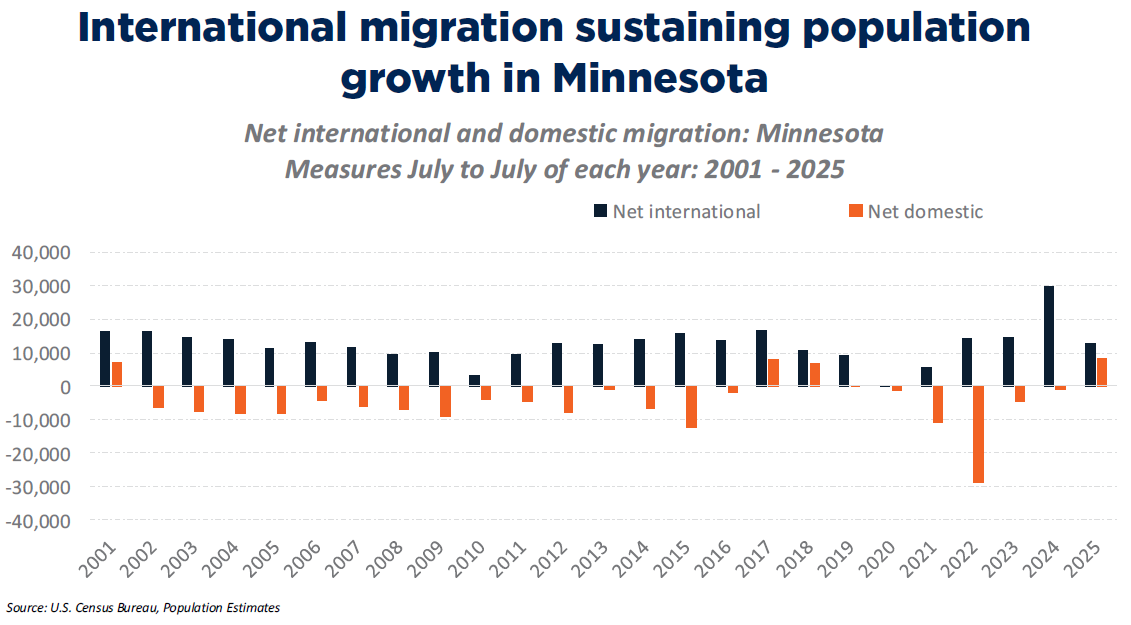
With slower natural population growth, Minnesota must compete more aggressively to retain and attract talent. The state has strong assets but has experienced net domestic outmigration in 20 of the past 25 years. Reversing this trend will require addressing the underlying drivers of migration.
RECOMMENDATION:
Expand housing supply to support population growth.
Minnesota needs more housing to support both population growth and affordability. Right now, limited housing supply makes it harder for people to move to or stay in many communities, as well as driving up costs. Reducing regulatory barriers and expanding more effective housing strategies would help increase the number of homes available, attracting new residents while improving cost stability.
RECOMMENDATION:
Evaluate tax policy’s impact on migration.
The state should take a closer look at how its tax system affects whether people choose to move to, stay in or leave the state. The evidence shows links between tax competitiveness and migration across states, with high tax states ranking near the bottom in net domestic migration this decade. A clearer understanding of these dynamics could inform reforms that improve Minnesota’s ability to attract and retain talent. It’s not currently clear how much taxes influence those decisions – but understanding that impact is critical as Minnesota works to attract and retain talent.
RECOMMENDATION:
Leverage higher education to attract and retain young talent.
Minnesota can better capitalize on its colleges and universities by attracting out-of-state students and strengthening pathways into local careers after graduation. More coordinated efforts between higher education and employers could improve retention of young adults – a key driver of migration trends.
RECOMMENDATION:
Strengthen legal immigration pathways and integration efforts.
Minnesota should strengthen its ability to attract and integrate international talent to support workforce and population growth. While federal policy sets the rules for immigration, state and local actions can help support international talent by improving transitions from education to employment, helping employers access global workers and accelerating workforce integration for new arrivals. Building on the state’s existing strengths in immigrant workforce participation can support long-term population and economic growth.
Back to top
About the Minnesota Chamber Foundation
The Minnesota Chamber Foundation is the state’s leading private-sector resource on the performance of Minnesota’s economy. Its first economic research— Minnesota: 2030 was released in 2021 as the state was emerging from the pandemic. This flagship report details the state’s economic assets and challenges, and provides dozens of recommendations and strategies to accelerate Minnesota’s growth leading to 2030.
Additional reports from the Foundation detail the benefits of immigrants to the state’s economy; the state of entrepreneurship and consistent updates to our original Minnesota: 2030 report. Looking ahead, the Foundation will produce a piece on migration trends in Minnesota. Domestic migration and immigration are critical factors that impact the growth of the economy, but are often misrepresented or misunderstood.
The Foundation’s work has become a trusted resource for the media, policymakers and business leaders. The data and research help inform business decisions and policy solutions.
The Foundation is also home to a nation-leading workforce inclusion initiative. Designed to be a practical approach to accommodate all dimensions of diversity across Minnesota, our efforts have gained tremendous momentum with small and mid-size businesses and those located in Greater Minnesota. These companies comprise the majority of Minnesota workers, and business leaders understand both the economic and moral imperative to creating inclusive work environments.
In addition, our partnership with local chambers of commerce through our Business Education Network continues to grow, connecting students to high demand careers in their communities.
To learn more about the Foundation’s work, please contact the staff listed on the back of this report.
We welcome your engagement and your investment in our efforts.